


Imagine you are a small business owner. You have saved up a budget to run your first ad on Spotify. You log in and are ready to go.
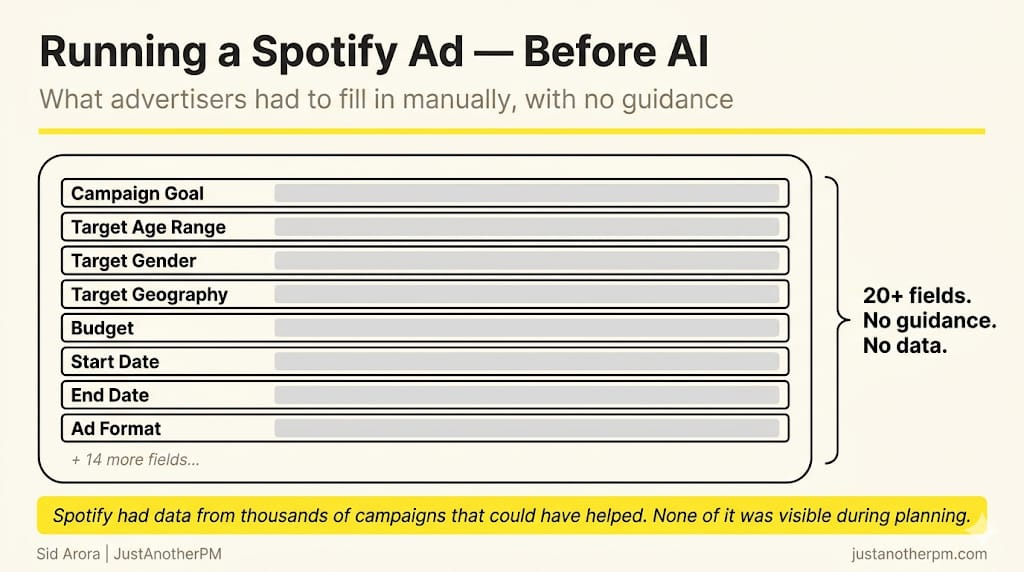
But, you are staring at a form with more than 20 fields, such as goal, target audience, age range, gender, geography, budget, start and end date, ad format, and on and on…
You don’t know what most of these mean. You don’t know what numbers to put in. You don’t know what a good budget looks like for your goal, or which audience settings have actually worked for similar campaigns in the past.
Spotify has that data, but none of it is visible to you. You are flying blind.
This is what campaign creation looked like on Spotify before they rebuilt it with AI.
Why This Was Hard to Fix
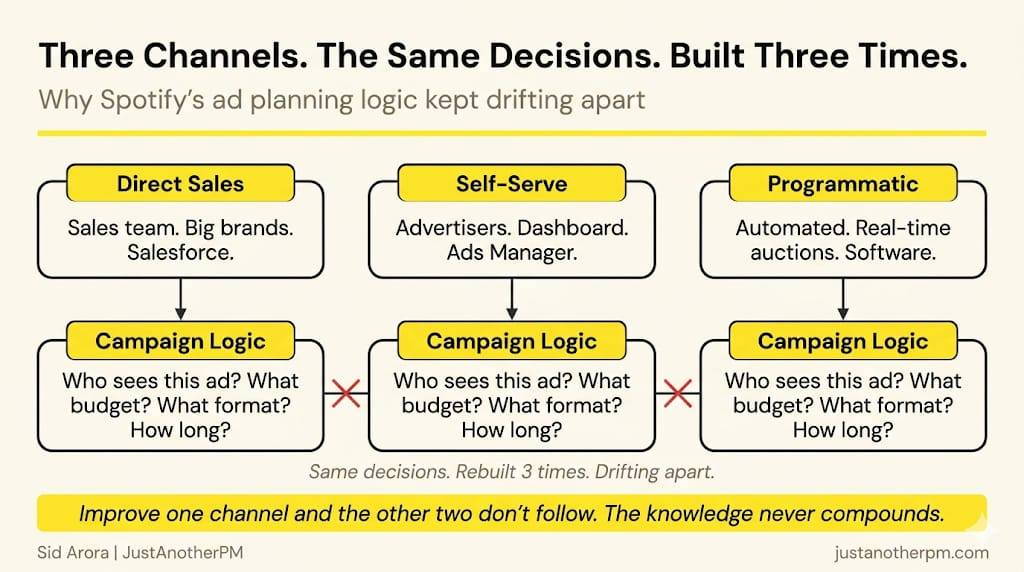
Spotify sells advertising in three different ways.
- Some advertisers work directly with Spotify’s sales team, usually big brands with large budgets, negotiating deals over email and calls.
- Some advertisers set up their own campaigns through Spotify Ads Manager, a self-serve tool like a dashboard.
- And some ad slots are sold automatically through programmatic auctions, where software buys and sells ad inventory in real time.
Three different channels. Three different types of advertisers. Three different surfaces.
But here’s the problem: the core decisions behind every campaign are the same regardless of which channel you use. Who should see this ad? What’s a reasonable budget for the goal? What format works best? How long should the campaign run?
Spotify answered these questions three different times.
Once for the sales team’s tools, once for the self-serve dashboard, once for the internal Slack workflows used by planners.
The same logic, rebuilt three times, drifting further apart with every update.
If someone discovered a better way to optimise budget allocation, they had to implement it in three places. If one channel got smarter, the other two didn’t automatically follow. The knowledge was fragmented.
What They Built Instead
Spotify’s engineering team decided the real problem wasn’t the form.
It was the absence of a brain.
Their systems were good at executing instructions, such as creating a campaign line item, running a forecast, and pulling an audience segment.
What they couldn’t do was take a goal, “I want to reach young music fans in Brazil without blowing my whole budget on video ads,” and turn it into a coherent plan that worked across every channel.
So they built one. They called it Ads AI. The idea behind Ads AI is straightforward, even if the implementation isn’t: instead of making advertisers fill out 20 fields, let them describe what they want in plain language.
Then have AI figure out the fields. You type: “I want to grow brand awareness among 18–24 year olds in Germany with a €5,000 budget over 30 days.”
Ads AI reads that, figures out your goal, identifies the right audience settings, parses the budget, sets the dates, looks at what similar campaigns have done in the past, and hands you back a complete, optimised media plan.
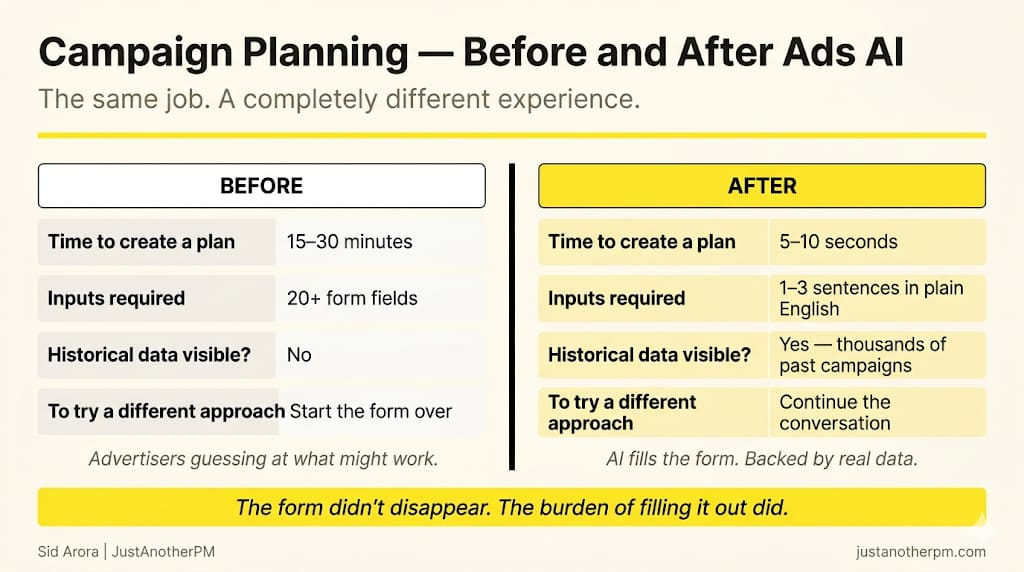
What used to take 15–30 minutes now takes 5–10 seconds.
How It Works: A Team of Specialists
Here’s where it gets interesting and worth understanding, because the approach Spotify took is the same approach that will show up in AI products across every industry.
They didn’t build one AI that tries to do everything. They built a team of AIs, each responsible for one specific job.
Think of it like a relay race. You say what you want. A coordinator reads your message and decides which specialists need to get involved. Each specialist handles their part.
Then a final AI takes everything the specialists figured out and assembles the complete plan. Here’s what each specialist does:
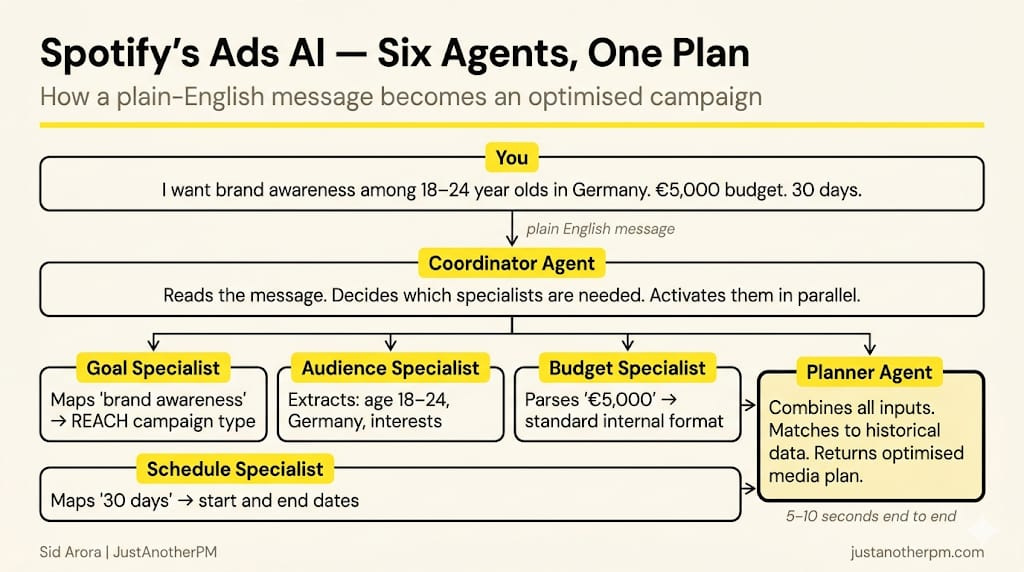
The coordinator reads your message first. It checks: has the user mentioned a goal? A budget? A location? Based on what’s missing or present, it decides which specialists to activate. It doesn’t call everyone every time, only those who are needed.
The goal specialist takes whatever you wrote about your objective. “I want more people to know my brand” or “I need app downloads,” and maps it to the specific campaign type the system understands: reach, clicks, app installs, and so on.
The audience specialist pulls the targeting details from your message. If you wrote “18–24 year olds who like hip-hop in Brazil,” it extracts the age range, the interest category, and the geography, all from plain English, no dropdowns required.
The budget specialist handles money. Advertisers write budgets in wildly different ways: “$5,000”, “5k”, “around fifteen grand”, “€10,000”. This specialist normalises all of those into a consistent number that the rest of the system can use.
The schedule specialist handles dates. Including relative ones like “starting next month” or “for the next 30 days.”
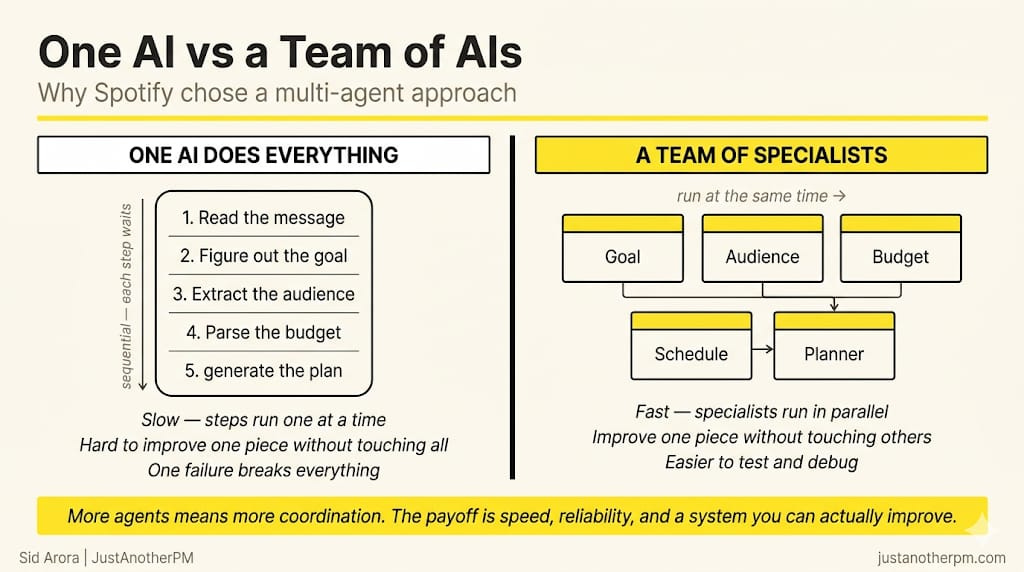
All four specialists run simultaneously, in parallel. They don’t wait for each other. Once they’re done, their results flow into the final and most important piece.
The planner takes everything: your goal, your audience, your budget, your dates, and generates specific campaign recommendations. Not generic suggestions.
Recommendations backed by data from thousands of past Spotify campaigns: what formats worked, what audiences performed, what budgets delivered results for goals like yours.
Liking this post? Get the next one in your inbox!
Why Build Six AIs Instead of One?
This is the question worth pausing on, because the answer applies far beyond Spotify.
You could theoretically give one AI all of this work: read the message, figure out the goal, extract the audience, parse the budget, handle the dates, and generate the plan.
One big model, one big prompt.
The problem is that the approach doesn’t scale and doesn’t improve well.
If you want to make the budget parsing smarter, you have to retrain or re-prompt the entire system. If the audience extraction breaks, it’s tangled up with everything else and hard to debug. And crucially, a single AI doing everything has to do it sequentially.
One step at a time. Six specialists working in parallel are faster.
Breaking the work into specialists means each piece can be improved independently. The goal specialist gets better without touching the budget specialist.
The planner can be updated with new campaign data without changing how dates are parsed. The system becomes easier to maintain, easier to test, and faster to run.
This is the core idea behind what engineers call multi-agent architecture: instead of one AI trying to solve the whole problem, you design a team of AIs where each one has a clear, bounded job.
Three Design Decisions Worth Understanding
The Spotify team made a few explicit choices that are worth knowing about, because they come up in almost every real AI product.
- Speed over completeness. Spotify chose to run the specialist agents in parallel, all at once, rather than sequentially. This makes the system faster but requires more coordination. The engineering tradeoff is complexity in exchange for a better user experience. Most AI product teams face this exact choice.
- Pre-computed data over live queries. The planner agent needs to look at historical campaign performance to make recommendations. Spotify keeps this data in memory, loaded and ready, rather than querying a database every time someone asks for a plan. A database query adds delay. In-memory access is near-instant. The tradeoff: the historical data isn’t always perfectly up to date, but the speed gain is worth it.
- Simple first, streaming later. The current version returns a complete plan once everything is ready. A more sophisticated version would stream results back in real time, you would see the audience spec appear, then the budget recommendation, then the full plan as each agent finishes. Spotify listed this as a planned improvement. Most teams start with the simpler version for good reason: it’s easier to build, easier to debug, and still delivers value.
What Changed
The numbers tell a clean story.
Campaign creation time dropped from 15–30 minutes to 5–10 seconds. The number of inputs required fell from 20 form fields to one to three sentences of plain English.
Every recommendation is now backed by data from thousands of real campaigns, data that existed before but was invisible to advertisers during planning.
But the change that matters most isn’t in the speed. It’s in the iteration model. Before, if you wanted to try a different audience, you started the form over.
With Ads AI, you just continue the conversation. “What if we extended the campaign to 60 days?” is a follow-up message, not a fresh form submission.
The AI already knows your goal, your budget, and your audience.
It adjusts the plan without losing context.
That’s a different relationship between a product and its user. One that feels less like filling out paperwork and more like talking to someone who knows what they’re doing.
The Bigger Idea
Spotify framed this project as fixing a structural problem.
It’s the same decisions being re-implemented three times across three channels, drifting apart, and are impossible to keep consistent.
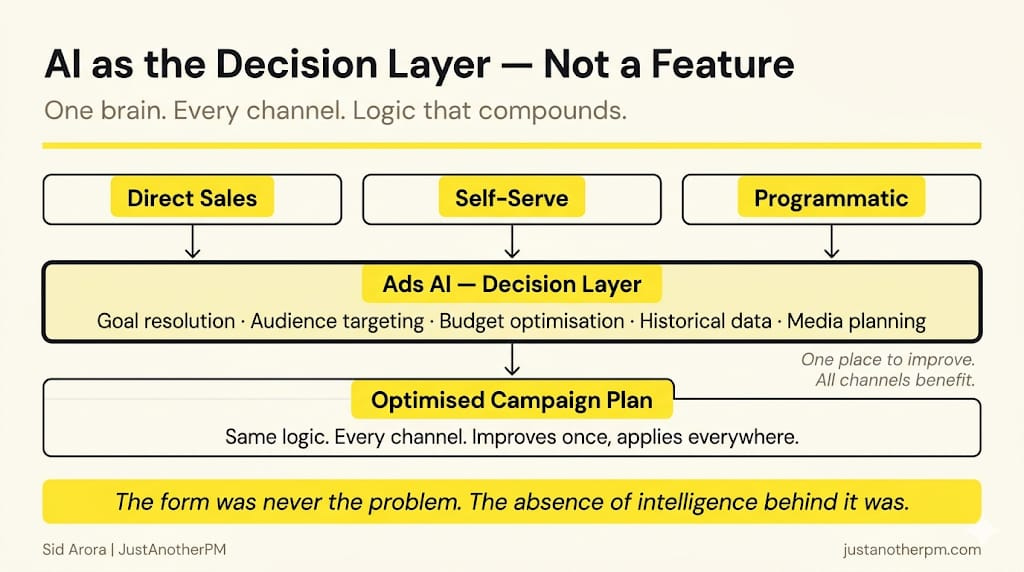
The multi-agent system solved that by creating a single decision layer.
One place where the logic lives. One place to improve it. Every channel, direct sales, self-serve, programmatic, now routes through the same brain.
As Spotify adds new channels or surfaces in the future, the intelligence doesn’t have to be rebuilt from scratch. It’s already there.
That’s the shift worth paying attention to: not AI as a feature bolted onto a product, but AI as the layer where decisions live. The form was never the problem. The absence of intelligence behind it was.
More from
Product Growth


