


In most countries, the idea of hopping on the back of a stranger’s motorcycle for a daily commute would sound unsafe or even absurd. In India, it has quietly become normal.
By mid-2025, Rapido was completing 33 lakh (3.3 million) rides every day across bikes, autos, and cabs. More than half of those were on motorcycles, a category Uber and Ola once dismissed as too small or too risky.
Rapido claims over 100 million downloads and 1 billion rides completed, making it not just a niche upstart but a mainstream mobility platform.
Uber’s own CEO, Dara Khosrowshahi, recently admitted that Rapido has overtaken Ola as Uber’s toughest rival in India.
The puzzle is obvious: why is this working at scale in India, when the same model has failed in most other markets?
On the surface, bike taxis should face three big problems: lower average fares, serious safety concerns, and unpredictable regulations.
Yet Rapido has grown steadily, narrowed its losses, and carved out a position alongside Uber in one of the world’s most complex transportation markets. The answer lies in understanding the realities of India’s commute, and how Rapido designed both its product and business model around those realities.
How Big Is Rapido
Before analyzing the “why,” it’s worth grounding in the “what.”
Rapido’s scale today is not speculative:
- 33 lakh (3.3Mn) daily rides in March 2025 (ET/PTI). More than 50% are two-wheelers. And 25M+ monthly active users across 500+ cities.
- FY24 revenue of ₹648 crore ($78Mn), with losses falling 45% year-on-year to around ₹370 crore ($42Mn), a sign of increasing efficiency.
- 1 million captains (drivers) on the platform, a meaningful base in a country with ~175 million registered two-wheelers.
- As of August 2025, Uber holds ~50% of four-wheeler rides, Ola ~30%, and Rapido ~20%. Uber’s CEO said that Rapido is gaining share faster than Ola.
These numbers are important for two reasons.
First, they positioned Rapido as a scaled consumer platform, not just a “bike taxi app.”
Second, they establish credibility.
Despite thin margins and regulatory challenges, Rapido is operating at real volume with improved financial discipline.
For context, Ola’s revenue in FY23 was somewhere around ₹2,799 crore ($319M).
Rapido is smaller, but not by an order of magnitude, and its growth curve is steeper. Rapido has proven that motorcycles, long ignored by global ride-hailing companies, can sustain a serious business in India.
India's Commute Crisis
Most urban Indians travel short distances every day: usually 5 to 7 kilometers.
But those short trips are not simple. Traffic congestion makes them long and frustrating. In Bengaluru, a 15 km commute averages 49 minutes. Public transport exists, but is often overcrowded, unreliable, and poorly connected.
Private cars remain aspirational, but too expensive for routine use, not only to buy, but also to operate in cities with scarce parking and rising fuel costs. This leaves two-wheelers as the country’s mobility asset by default.
India has over 175 million registered two-wheelers, accounting for nearly 75% of all vehicles on the road.
They are affordable, easy to get through traffic, and owned across socio-economic classes. What they lacked was an organized, trusted, and tech-enabled way to turn them into public mobility. And this is the opening Rapido saw.
If most trips are short, most households already own two-wheelers, and most commuters need an affordable option every single day, a bike-taxi network could fill a massive gap between expensive cabs and unreliable buses.
The “so what” is crucial. Rapido wasn’t just adding another transport option. Instead, it was addressing a structural mismatch in India’s urban mobility.
Cars were never the dominant mode. Two-wheelers were. By building its platform around the vehicle India already uses the most, Rapido started from a position of cultural and economic fit.
The Rapido's Core ₹50 Bet
At the heart of Rapido’s rise is a simple number, ₹50 ($0.5)
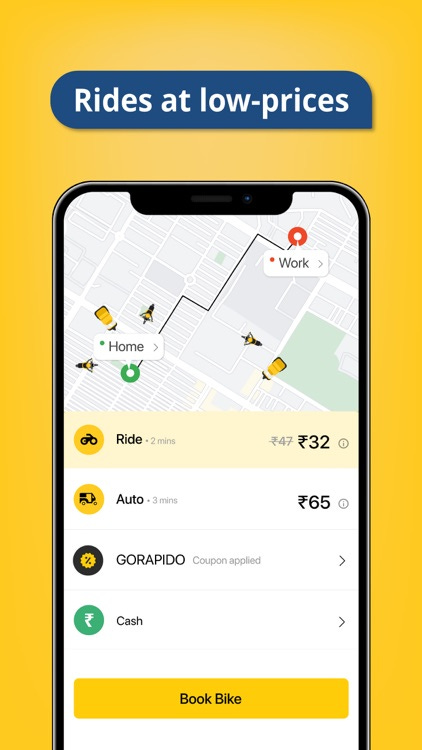
That is roughly the average cost of a short bike ride on Rapido in Indian cities. It may sound small, but in a price-sensitive country, that number hits the sweet spot between affordability and reliability.
But why does this matter? Consider the alternatives:
- An Uber or Ola cab for the same 5 km trip can easily cost ₹200–₹250, especially in peak hours.
- An auto-rickshaw might be cheaper, but fares are unpredictable and haggling is common.
- Public buses or metros are even cheaper, but rarely door-to-door and often overcrowded.
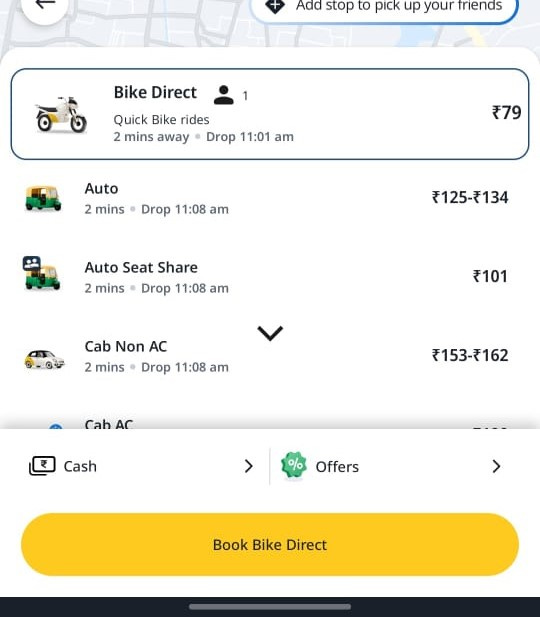
Rapido slotted itself neatly in the middle. For example, here’s a price comparison between Rapido and Uber. I gave BTM Layout 2nd Stage, Bangalore, as my pickup point and HSR Layout as the destination point.
The distance is around 4 kilometers. The prices look on both of these looks like this:
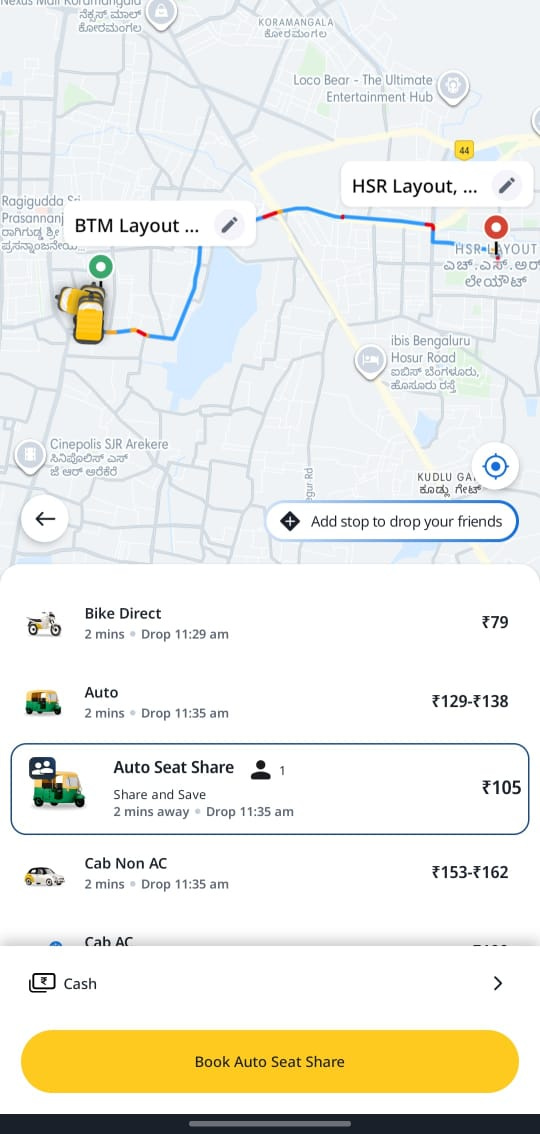
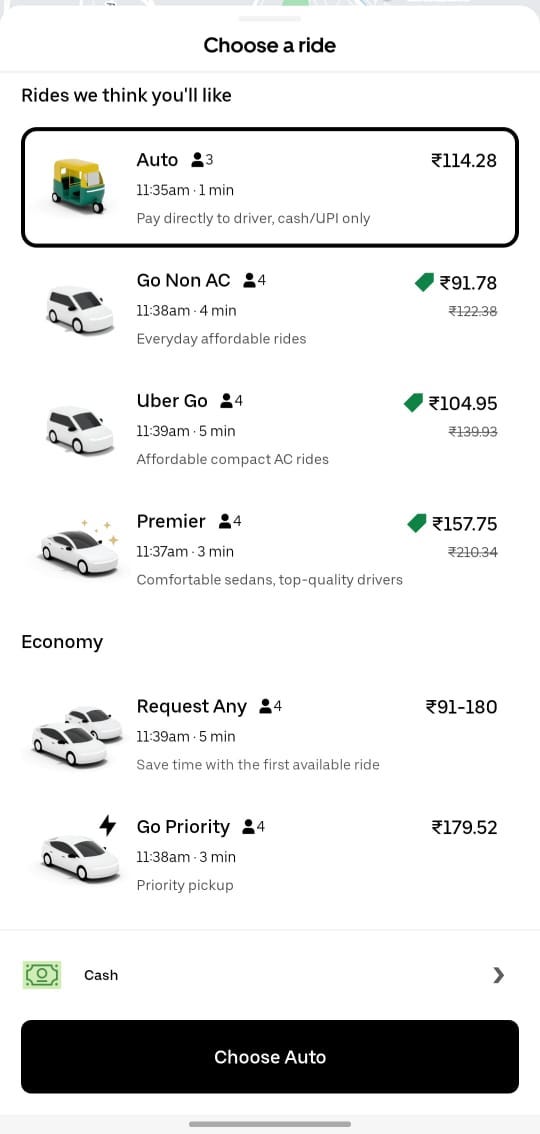
While the auto price on Rapido is a little high compared to Uber, Rapido still has an alternative option, auto seat share, at a cheaper price. These prices are cheap enough to use daily, but structured enough to feel reliable.
This was not just about user pricing, but also about supply economics. Anyone with a license and a two-wheeler could become a “Captain” on Rapido with almost no onboarding friction.
For many, this offered a way to monetize idle time or supplement income from delivery platforms like Swiggy or Zomato.
The learning here is simple: finding the right price point is not about matching competitors, it’s about solving the customer’s daily job-to-be-done.
Rapido made itself the default option for short trips because ₹50–₹100 was the band where demand existed, but no one else had built a structured product.
Designing for India
Rapido scaled is the way it designed its app for India’s realities.
Unlike Silicon Valley-styled apps optimized for the latest iPhones, Rapido had to work on low-end Android devices, patchy 3G/4G networks, and new digital payments users.
Several design choices stand out:
- Simplicity of flow: Booking a ride on Rapido is among the fastest in the industry. Users select the vehicle, drop location, and confirm with a PIN. There are no clunky OTP entries. Shaving even 10 seconds off will reduce abandonment.
For example:
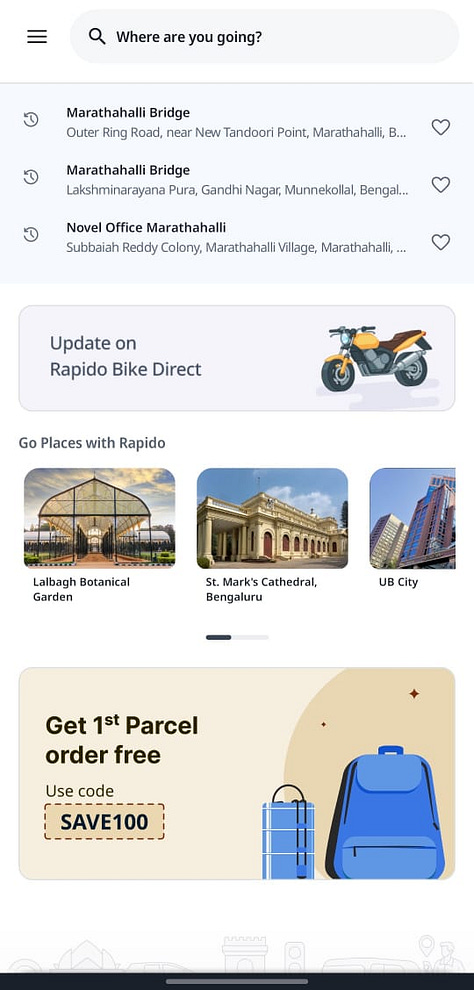
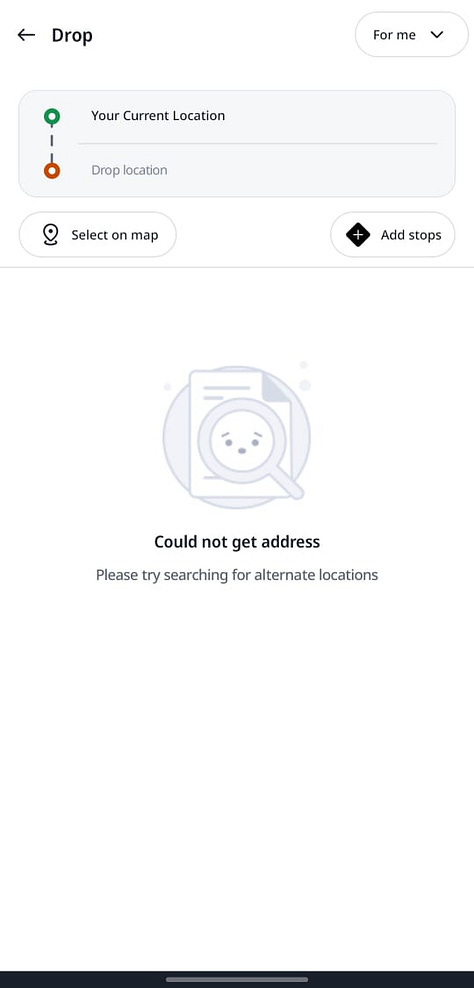
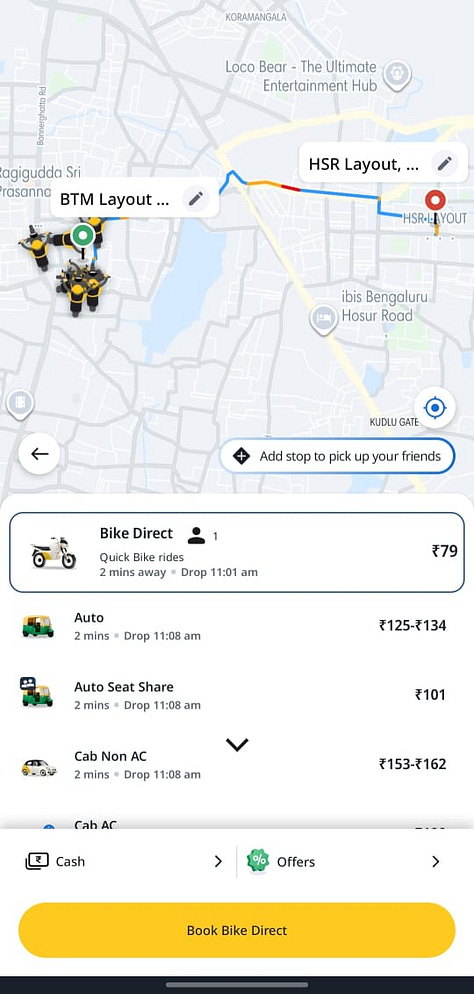
The interface is so good that as soon as you open the app, you will have a search button at the top (image 1). When you click on that, you will be asked to choose both pick-up and destination locations (image 2).
Once you choose locations, you will be taken to a page where you must select the vehicle you want to travel by. Is it by bike, car, or an auto? We even have several options under car and auto. Nothing is kept hidden. Prices are transparent.
Once you choose the transport option, click the bright yellow button at the bottom. That’s it. Your order will be confirmed if any of the available captains accept the ride.
You will then get an OTP, which you must share at the time of boarding.
- Localized UX: The app supports multiple Indian languages and uses a bold yellow-black color palette that is simple, high-contrast, and legible even on older screens. Instead of trying to be sleek, it tries to be clear.
- Trust signals: Safety has always been a barrier for bike taxis. Rapido surfaces the Captain’s photo, license plate, and helmet reminders upfront. It also includes Acko-backed ride insurance as a standard feature.
- Features built for habits: Subscriptions like Power Pass (monthly discounted rides) and Flexi Fare (letting riders choose their own price for autos) turn occasional users into repeat customers. These features address the real frictions of surge pricing and unpredictability.
- Multimodal integration: In 2025, Rapido began integrating Delhi Metro ticketing directly into the app, with flat ₹25 promos for metro-to-Rapido transfers. This transforms Rapido from just a ride-hailing app to a mobility hub for urban commuters.
The key insight here is that design was not just about UI.
It was about adapting to context.
By making its product accessible to low-end devices, trustworthy in a high-risk environment, and sticky for repeat usage, Rapido built an app that felt made for India.
Frugality as a Moat
The ride-hailing industry globally has been defined by subsidies and burn.
Uber and Ola famously spent billions in discounts to acquire customers, but they also built high fixed costs, complicated incentive schemes, and heavy infrastructure.
Rapido took a different approach. Its focus on bikes and autos naturally reduced costs:
- Lower onboarding costs for Captains (anyone with a bike, a license, and a smartphone could start).
- No need for car financing programs or luxury features.
- Lower rider subsidies, since the base fares were already attractive.
Even in its financial reports, this frugality shows up.
In FY24, Rapido cut its net losses by ~45% YOY, even as revenue grew to ₹648 crore.
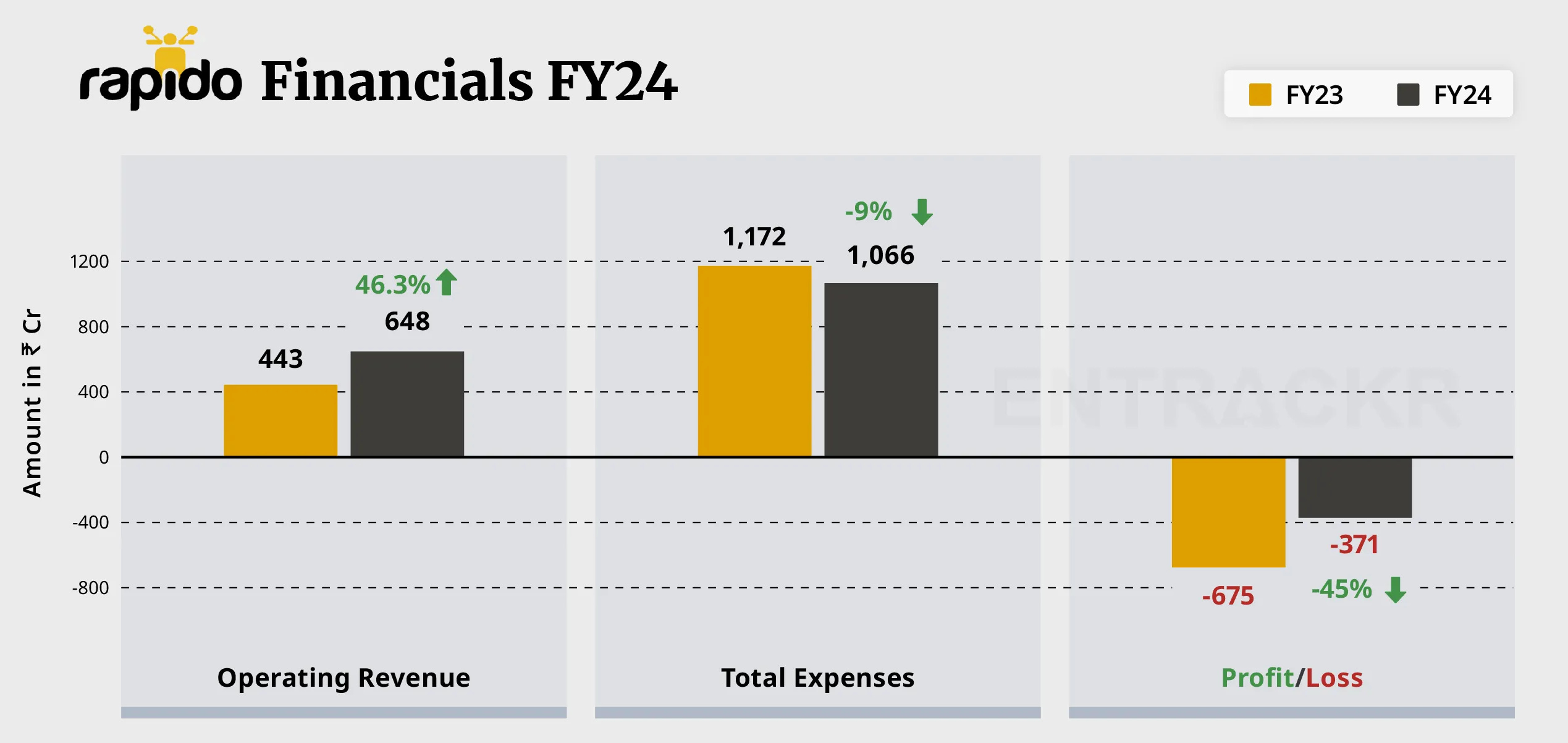
The company achieved this all by scaling daily usage without ballooning overheads.
On the supply side, Rapido introduced an unusual model. Instead of charging drivers a commission per ride (the standard for Uber and Ola), it experimented with a subscription-style platform fee.
That meant captains could keep more of each fare, making the platform more attractive for supply without Rapido having to invest in retention. The broader learning is that frugality is not just survival. It can be a moat.
In a price-sensitive market like India, keeping the unit economics lean allows a challenger to scale sustainably, while giants struggle under their own cost structures.
Liking this post? Get the next one in your inbox!
The Angles Others Missed
When Rapido launched in 2015, most analysts assumed it wouldn’t be successful. The conventional wisdom was that India’s ride-hailing future would be built around cars and, to a lesser extent, autos.
Uber and Ola doubled down on these categories. They dismissed bikes as “too small” to matter.
But Rapido saw three angles others overlooked:
- Tier-2 and Tier-3 Cities
Ola and Uber invested much in metros like Bengaluru, Delhi, and Mumbai, where higher ticket sizes and affluent customers justified subsidies. Rapido did the opposite.
It expanded aggressively into mid-sized cities like Vijayawada, Lucknow, and Bhubaneswar, places where bike ownership is super high, and traffic is dense.
Plus, cabs are not affordable for daily use. By 2025, more than 35% of Rapido’s rides came from smaller cities.
- Micro-Mobility, Not Margins
While Uber and Ola measured success in terms of average order value (AOV), Rapido measured it in terms of repeatability. A ₹250 cab ride is lucrative once, but a ₹50 bike ride used twice a day is a recurring habit.
By optimizing for frequency, Rapido built a strong relationship with commuters.
- Everyday Integrations
Rapido didn’t stop at point-to-point trips.
It embedded itself into the commuter’s broader routine:
- Partnerships with IRCTC and metro stations for “first-mile/last-mile” journeys.
- Tie-ups with Swiggy and Zomato for flexible captain earnings.
- Integration of metro ticketing inside the Rapido app itself.
Each of these created distribution channels Uber and Ola couldn’t easily replicate.
Sometimes the overlooked segments are not just gaps, but leverage points. By owning bikes and tier 2 and 3 cities, Rapido wasn’t just competing with Uber and Ola. It was building defensible ground. They had no incentive to prioritize.
The Dark Side of the Bike Taxis
Of course, Rapido’s choices came with risks.
Regulatory Uncertainty
Bike taxis sit in a legal gray zone in India. In Delhi, they were banned outright in 2023. In Maharashtra, regulators forced a suspension. In Karnataka, courts and governments have flip-flopped repeatedly.
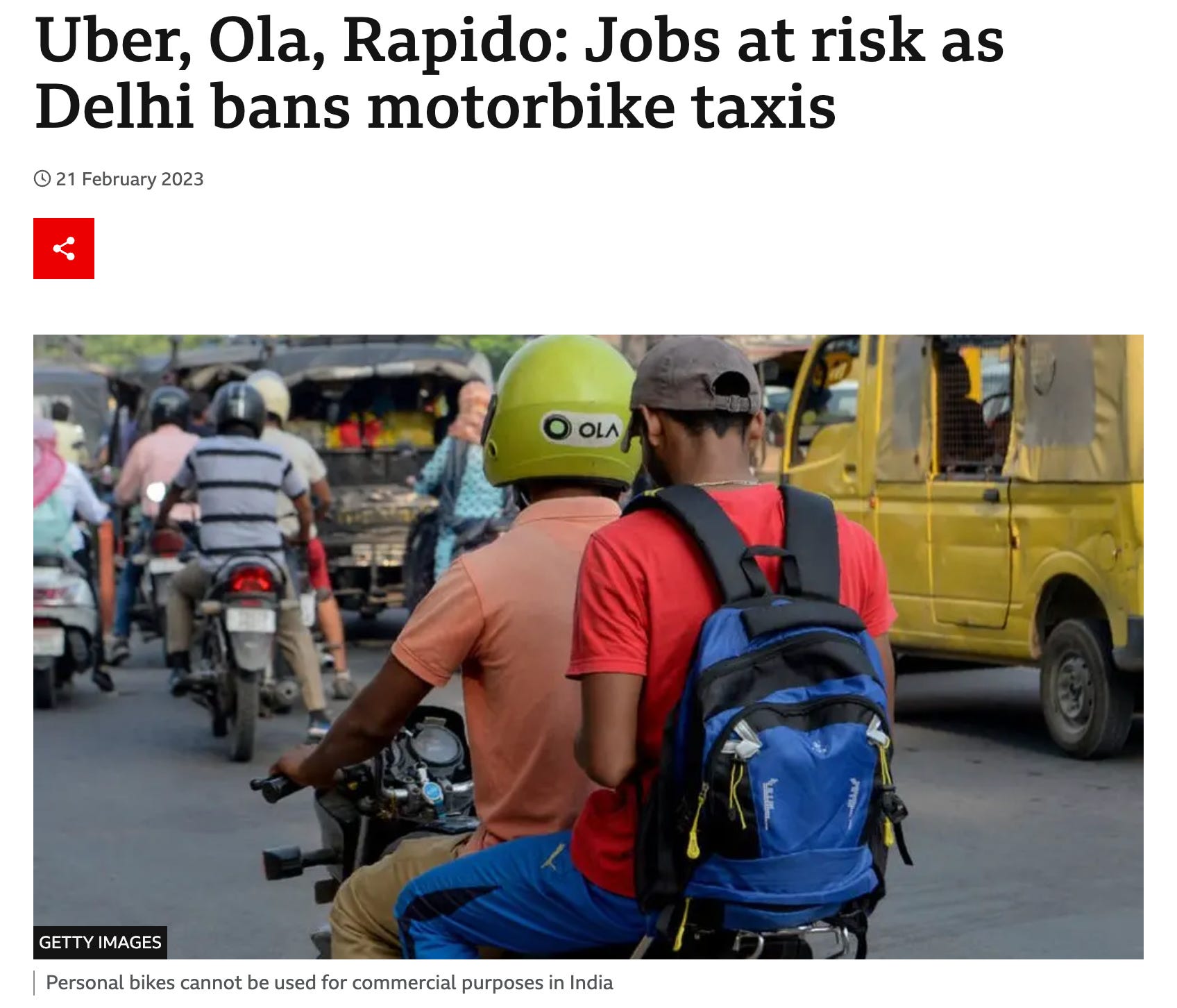
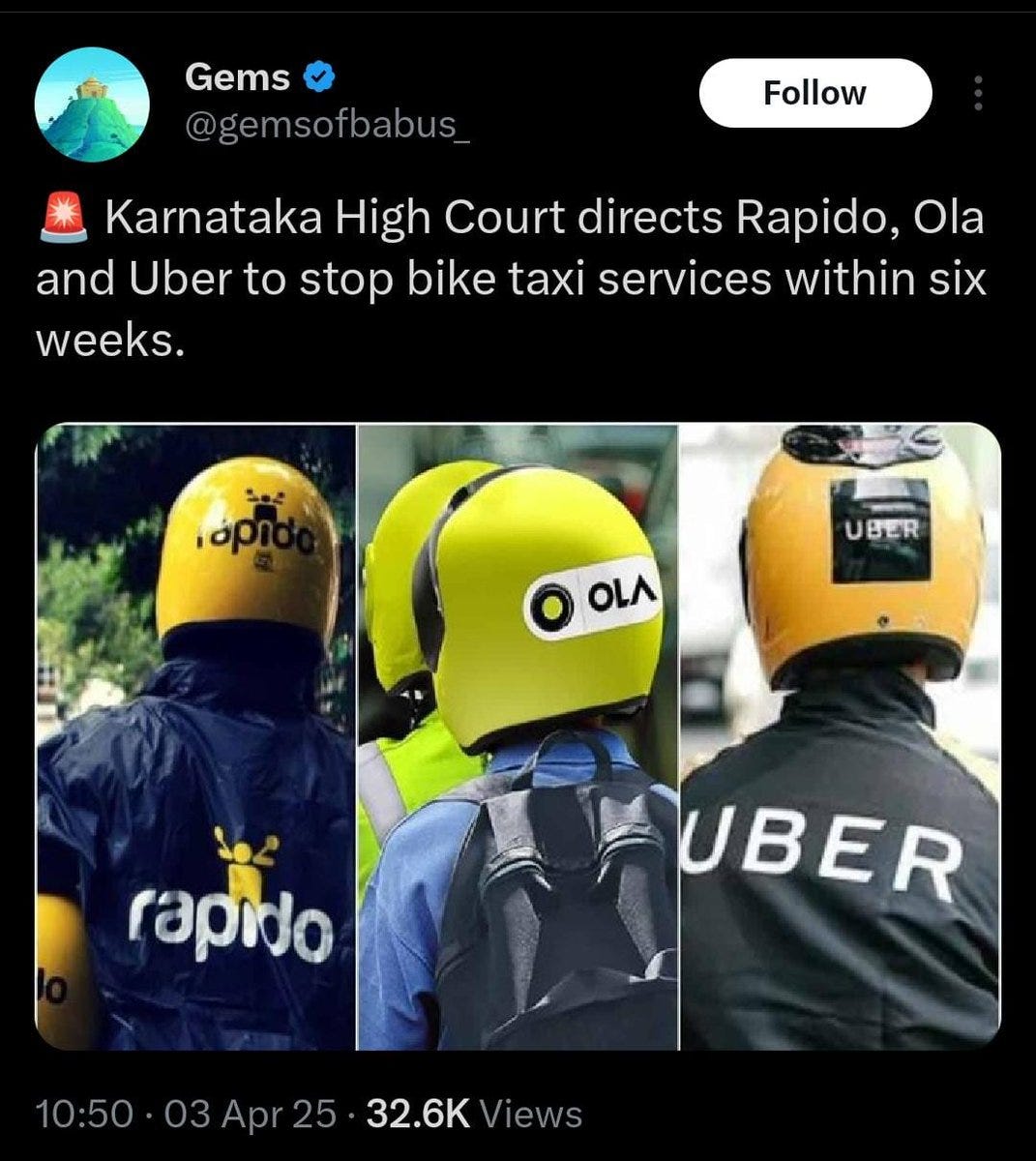
For context, India only introduced a central framework, the Motor Vehicle Aggregator Guidelines, in 2025. That formally legalized bike taxis nationwide. But states still control enforcement, and not all have implemented the rules uniformly.
This means Rapido’s core category could disappear overnight in key markets, depending on political winds.
Safety Concerns
Two-wheelers account for the majority of road fatalities in Indian cities. This creates an inherent trust problem.
Rapido’s measures, such as helmets, Acko-backed ride insurance, and visible safety prompts, do not eliminate the concern. Women riders in particular often see bikes as riskier than cars or autos.
Thin Margins
With average fares of ₹50–₹100, bikes generate lower revenue per ride than cars.
Scaling up requires massive volume, which Rapido has achieved, but profitability remains elusive. Even with narrowed losses in FY24, the company is still in the red.
The key point is that Rapido’s bet is structurally fragile. It has worked because India’s conditions made it viable: short trips, bike density, price sensitivity. But it is now exposed to regulatory shocks and safety perception.
India’s Everyday Mobility Layer
Despite these risks, Rapido is playing a long game that goes beyond bike taxis.
- Logistics and Deliveries: With a large base of bike captains, Rapido moved into last-mile delivery for partners such as Swiggy and Flipkart. This diversifies revenue and makes its captain network more productive.
- EV Transition: Rapido has started pilots with electric two-wheelers in Delhi, aligning with government pushes for clean mobility. If successful, this could reduce operating costs and strengthen Rapido’s compliance narrative.
- Becoming a Mobility Hub: The integration of metro ticketing is a telling sign. Rapido wants to be the interface for urban commuting. By combining bikes, autos, cabs, and now the metro, it positions itself as the everyday mobility layer.
Rapido isn’t trying to be Uber’s global rival. It’s just trying to own India’s daily, local mobility stack. That is a narrower ambition, but one that fits the market far better.
Lessons For Product Managers
1. Find the overlooked “₹50 gap.”
The most obvious opportunity isn’t always the biggest one. By solving the small but daily pain point (cheap, short trips), Rapido unlocked a massive habit-forming market.
As a PM, ask: what is the underserved job-to-be-done that others dismiss as too small?
2. Build for context, not aspiration.
Uber and Ola were built around cars, assuming India would follow Western patterns. Rapido was built around two-wheelers because that’s what people actually used.
Design for the assets and behaviors that already exist in your market.
3. Frugality compounds into defensibility.
Subsidies can buy short-term growth, but lean models scale more sustainably.
Rapido’s low onboarding and driver-friendly subscription model gave it a structural advantage. Efficiency, especially in price-sensitive markets, is a moat.
In a Nutshell
On paper, Rapido should not exist at scale. Its main product, bike taxis, is illegal in some states, carries lower fares than cars, and comes with higher safety concerns.
Yet in 2025, it is completing more than 33 lakh rides daily, has over 100 million downloads, and is acknowledged by Uber itself as its biggest competitor in India.
The reason is not luck. Rapido succeeded because it was built for the India that exists, not the India that investors imagined. Cars were never the dominant mode of transport here. Two-wheelers were.
Commutes were not 15–20 km journeys, but short 5 km hops. Riders were not looking for aspirational comfort. Instead, they wanted something cheap, fast, and reliable enough to use daily.
By anchoring on this reality, Rapido created a platform that felt natural to Indian commuters. Its design choices (fast booking flow, Flexi Fare) reduced friction.
- Its frugal operations gave it a cost advantage.
- Its expansion into tier-2/3 cities built defensibility.
- And its shift into multimodal (autos, cabs, metro) shows a path to becoming a true mobility hub.
If you design for the actual conditions of a market, you can win against much bigger competitors.
Rapido has proven that in India.
That’s it for today!
More from
Fundamentals of Product Management


