


Hey hey,
In 2024, the most downloaded free app in the US was not Instagram. Not TikTok. Not ChatGPT. It was Temu, a Chinese shopping app that most Americans had never heard of, eighteen months earlier.
By the end of 2024, Temu had been downloaded over 483 million times globally, had 416 million monthly active users, and its parent company, PDD Holdings, was generating $54 billion in annual revenue.
Colin Huang, the founder, briefly became the richest person in China with a net worth of over $48 billion. Then, in May 2025, the US government closed a tax loophole, and Temu's entire model started unravelling.
Prices doubled overnight. The app plummeted from #3 to #85 in the App Store in two weeks. European regulators raided their headquarters.
This is the story of how Temu built the fastest-growing e-commerce company in history and how one rule change exposed the fragility underneath.
The Loophole That Made It All Possible
To understand Temu, you must know one US trade rule: the de minimis exemption. Since 2016, any package entering the United States worth less than $800 was exempt from customs duties and most inspections.
The rule was designed for the occasional pair of shoes someone ordered from overseas. It was never designed for what came next. At its peak, Temu and Shein together shipped 600,000 packages a day to Americans under this rule, over 30% of all daily de minimis shipments.
Each package was a cheap item, shipped directly from a Chinese factory to a doorstep in Ohio without tariffs, import duties, and with minimal customs checks. By 2023, 1.36 billion packages entered the US under the de minimis exemption annually, up from 134 million just a decade earlier.
Temu and Shein together accounted for over 30% of them. This was not a side benefit of Temu's model. It was the model.
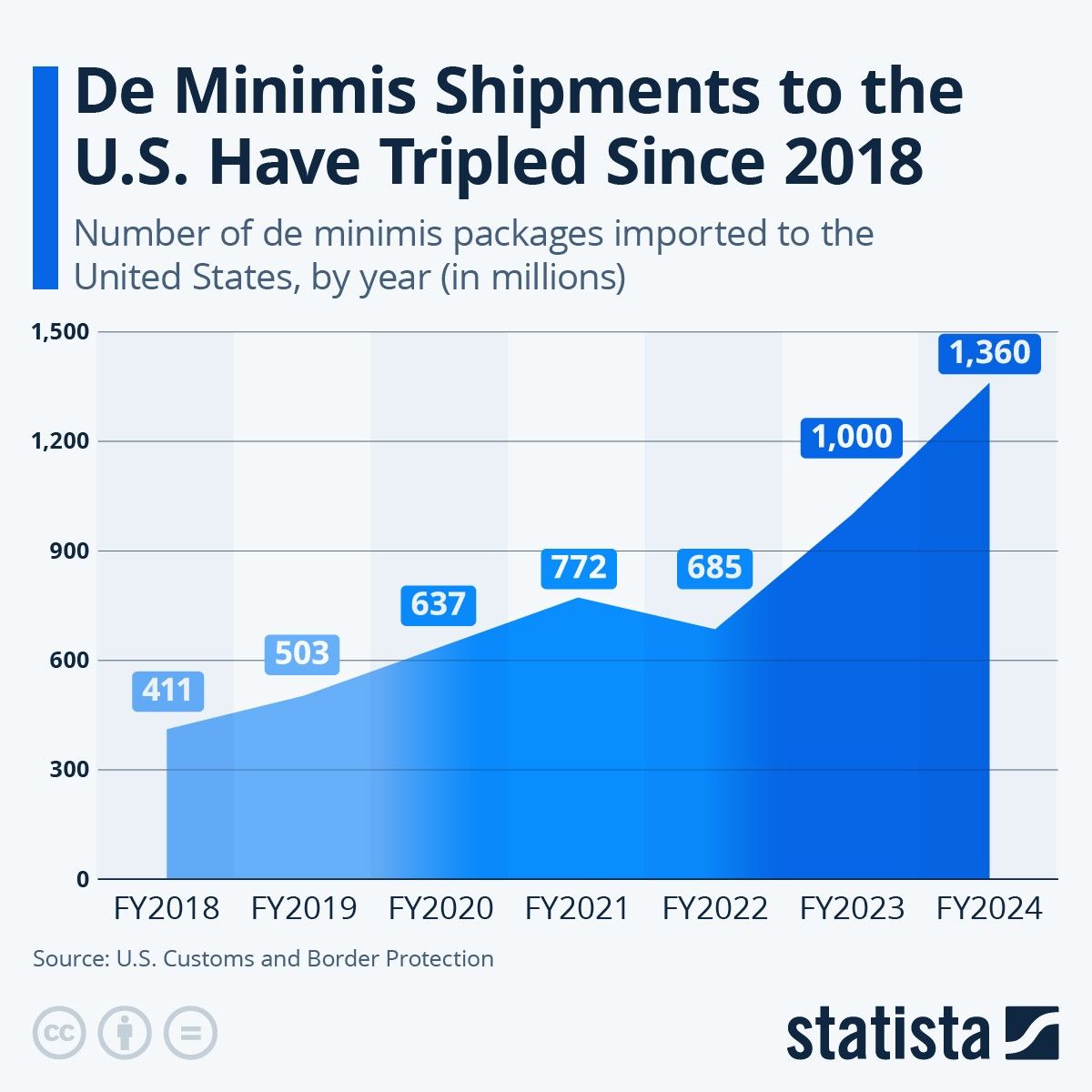
De minimis shipments into the US grew from 134 million to 1.36 billion annually in under a decade (Source)
How the Machine Worked
PDD Holdings launched Temu in September 2022, built on a playbook its founder, Colin Huang, had already perfected in China.
Huang founded Pinduoduo in 2015, a group-buying platform that became one of the largest e-commerce companies in China by connecting consumers directly with manufacturers. It was just factories shipping straight to phones.
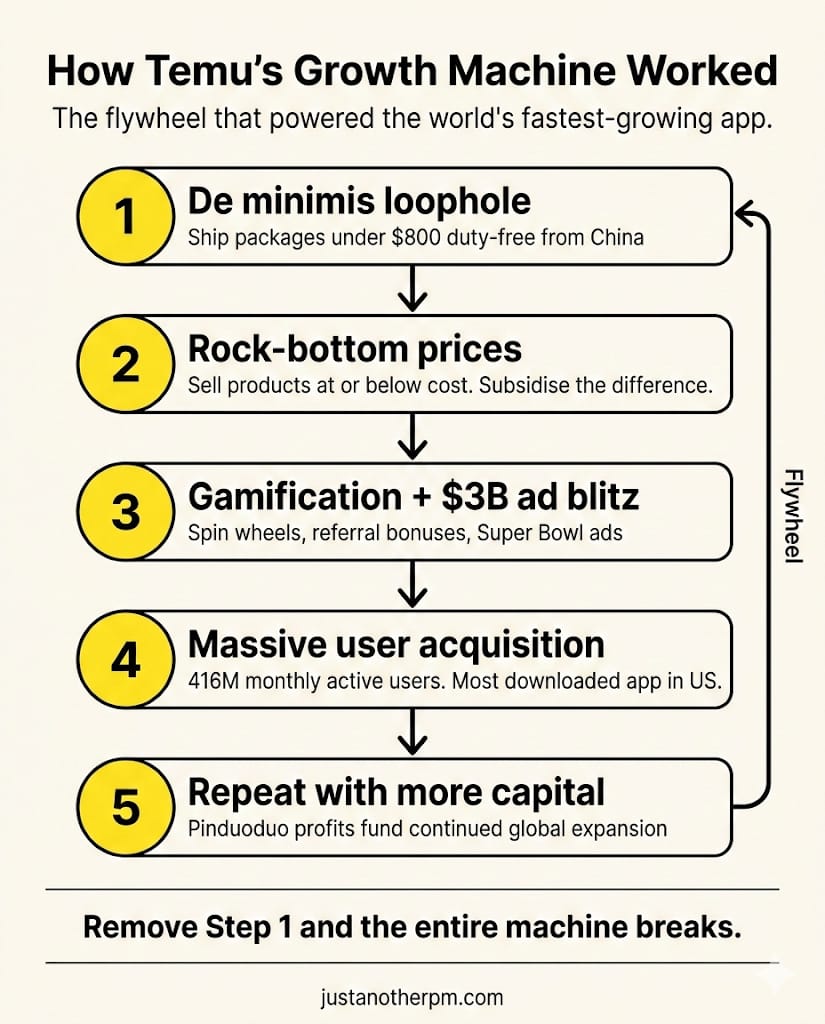
Temu was Pinduoduo for the rest of the world. The idea was to take the same factory-direct model, combine it with the de minimis loophole, and make everything absurdly cheap. A summer dress for $18. A phone case for $2. Children's toys for less than a coffee.
The prices were not sustainable, and Temu knew it. It burned through an estimated $3 billion in 2023 alone, selling many items at or below cost.
This was a classic land grab: acquire users now, figure out margins later. PDD Holdings could afford the losses because Pinduoduo was very profitable in China, effectively subsidising Temu's global expansion.
But low prices alone do not make an app the most downloaded in America. Temu needed another engine: addiction.
Gamification as a Growth Strategy
Open the Temu app, and you immediately land on a slot machine, not a landing page. Spin-to-win wheels. Daily check-in rewards. Mystery boxes.
Countdown timers on flash sales. A virtual farming game where you grow crops and earn real discounts. Referral bonuses worth up to $100 in credits for inviting friends. Retail analyst Neil Saunders described it better: "Temu is as addictive as sugar."
Researchers identified the mechanics as variable ratio support schedules, the same psychological pattern that makes slot machines compelling. You never know when the next reward is coming, so you keep spinning.

Then came the marketing blitz. Temu spent nearly $3 billion on digital advertising in the US in 2023, making it one of the biggest online advertisers in the country. Reports suggest close to $2 billion went to Meta alone.
Ad spend jumped 1,000% YOY. For the 2024 Super Bowl, Temu bought three ad slots at $7 million each. The tagline: "Shop like a billionaire." The strategy worked.

In 15 countries, including the US, UK, Germany, Japan, and Brazil, Temu was the most downloaded shopping app in 2024.
The Collateral Damage
While Temu grew, American retailers bled. Etsy's CEO publicly said that Temu and Shein were "almost single-handedly having an impact on the cost of advertising," driving up customer acquisition costs on Google and Meta for everyone else.
In March 2025, Forever 21 filed for bankruptcy for the second time in six years. They explicitly named Temu and Shein as the cause. All 354 US stores closed by April 30.
They said that it had been "materially and negatively impacted" by their use of the de minimis exemption, which gave overseas competitors a structural cost advantage that no domestic retailer could match.
Forever 21 was the most visible casualty. It was not the only one.

Liking this post? Get the next one in your inbox!
Then the Loophole Closed
On April 2, 2025, President Trump signed an executive order closing the de minimis exemption for imports from China, starting May 2, 2025. Overnight, every package Temu shipped from China to the US was subject to tariffs of up to 145%. Temu's response was immediate.
On April 25, the app added "import charges" to every product. An $18 dress became $45. A $12 children's bathing suit cost $31 with the surcharge. Prices effectively doubled. Within days, Temu reversed course.
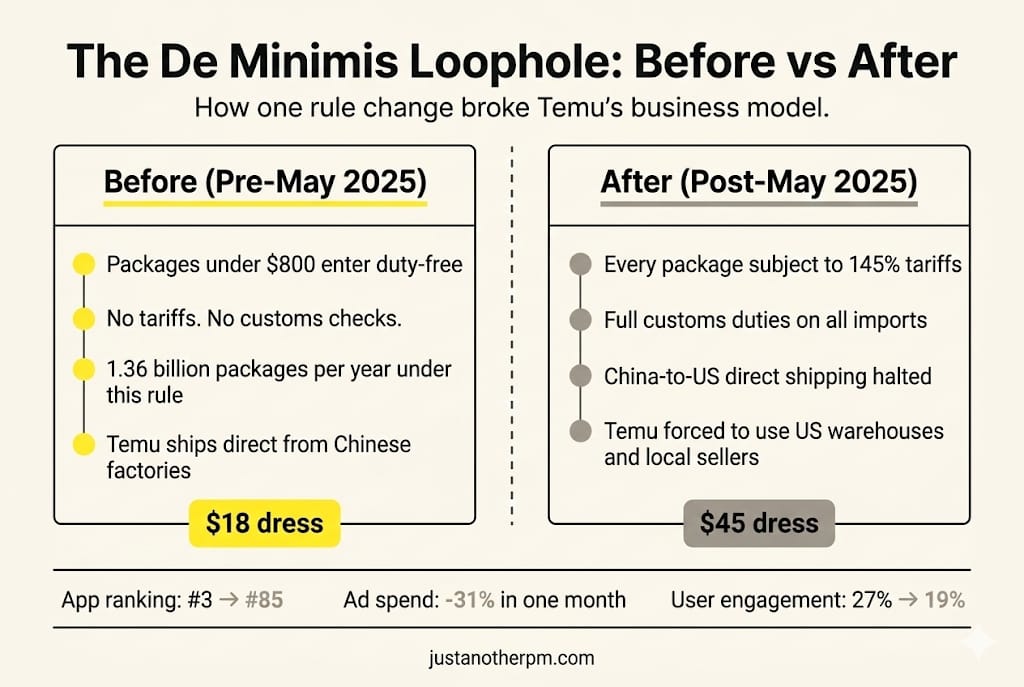
It halted all direct shipments from China to US buyers and switched its American storefront to only display products from US-based warehouses and local sellers. The pivot was fast, but the damage was done. Temu's US ad spend dropped 31% in April.
The app fell from #3 to #85 in the App Store. US user engagement declined from 27% in September 2023 to 19% by April 2025.
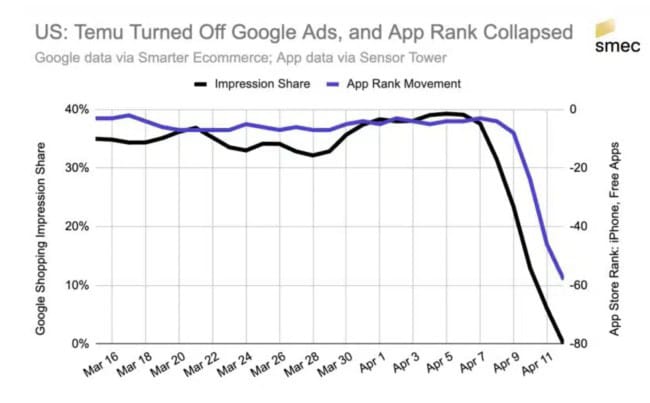
The product that was built on a loophole could not survive without it.
The Reckoning Beyond Tariffs
The de minimis closure was not the only problem. Regulators worldwide were closing in. In July 2025, the European Commission found Temu in preliminary breach of the Digital Services Act.
Consumer testing found that 95% of toys purchased on Temu violated EU safety regulations. Some contained phthalates at 240 times the legal limit.
A children's toy tissue box had excessive formaldehyde. In January 2026, the EU raided Temu's Dublin headquarters, investigating whether the company benefited from illegal Chinese state subsidies.
The same month, Turkish authorities raided their Istanbul office. Poland fined them for fake discount advertising. In the US, 21 state attorneys general demanded answers about forced labour in Temu's supply chain. A Congressional report found "extremely high risk" that Temu's products were made with Uyghur forced labour.
Temu admitted it had no policy prohibiting goods from Xinjiang. Nebraska sued the company, alleging the app functioned as spyware. PDD Holdings' stock fell roughly 30% from its November 2025 peak. Revenue growth slowed from 59% in 2024 to single digits.
Where Temu Stands Today
Temu is not dead. It still has hundreds of millions of users globally.
It still dominates some European markets. PDD Holdings remains profitable because Pinduoduo, its Chinese platform, prints money. But the American story, the one that made Temu famous, has changed. The US storefront now shows only locally fulfilled products.
The prices are no longer jaw-droppingly low. The ad spend has been cut. The de minimis loophole, which enabled the entire model, is gone. And the pressure is not just American. The EU plans to scrap its own duty-free allowance on parcels under £150 by July 2026.
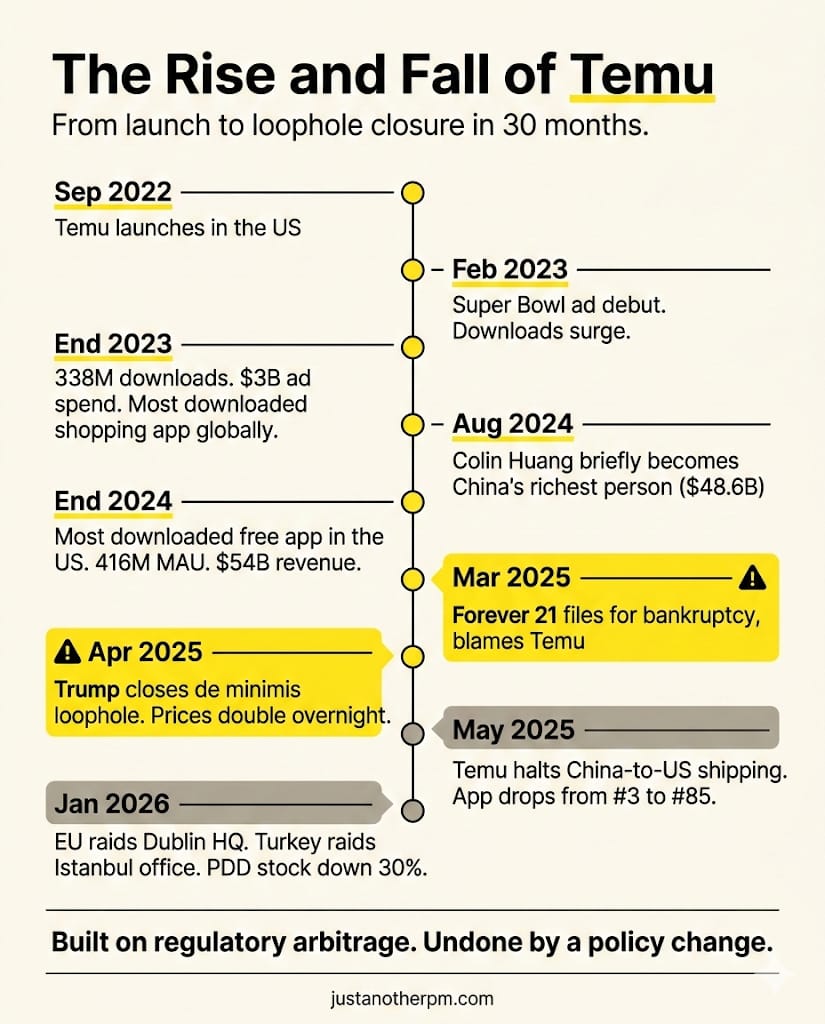
Turkey has already done the same, and Temu temporarily suspended sales in the country entirely. The regulatory arbitrage that powered Temu's growth is closing, market by market. An industry analyst put it this way: "Temu's original 'China-to-door' model was brilliant but ultimately fragile, built on regulatory arbitrage."
That is the line worth remembering. Temu did not build a product moat. It built a regulatory one. And regulatory moats, unlike product moats, can be taken away with a signature. They acquired 416 million users in under three years.
That is extraordinary execution. But the business model underneath, subsidised prices, a tax loophole, minimal safety checks, and $3 billion a year in advertising, was always a house of cards waiting for a policy wind. The question is not whether Temu can survive.
It probably can, in some form. The question is whether a company that grew by being the cheapest option in the room has anything left to offer when it can no longer be the cheapest. What would you have done differently?
That's it for today. See you in the next one,
— Sid
P.S. We recently launched a 6-day email course on AI Product Management, and have got 600+ signups already. If you haven’t already, feel free to see the details here.
This article draws on publicly reported financial data, regulatory filings, and investigative journalism. If you spot any inaccuracies, please let me know.
More from
Other


Did You Know LLMs Actually "Think"?

What's Happening To Temu?


